Fast port scanner with desktop GUI vs Masscan and Nmap
Masscan can transmit millions of packets per second across the Internet, but running it on a local Wi-Fi or office network often saturates home routers and causes packet drops. Here is how modern async scanning balances speed, reliability, and safety.
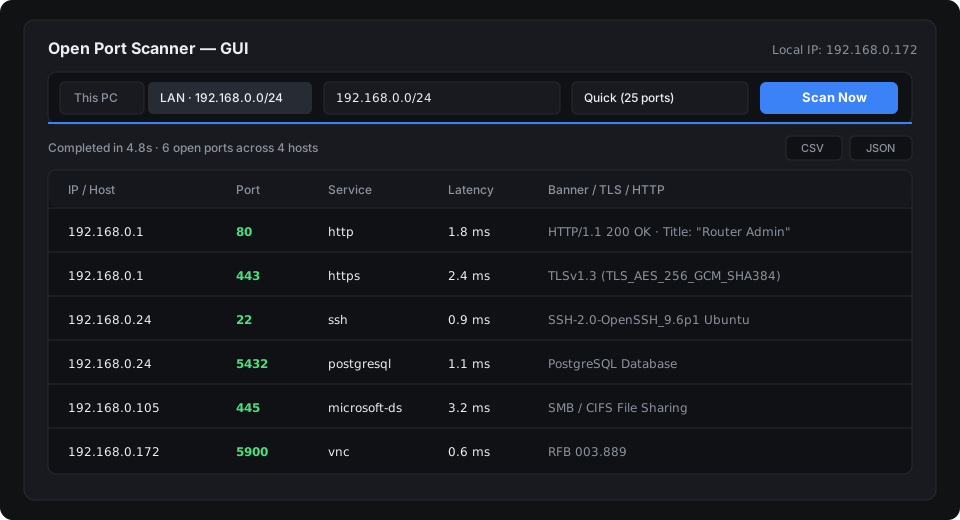
The risk of raw packet flooding on local subnets
Masscan operates by generating raw asynchronous TCP SYN frames using its own custom TCP/IP stack. While unmatched for Internet-scale reconnaissance, this approach causes notable drawbacks for internal office and homelab scans:
- Router state exhaustion: Consumer and small business routers maintain NAT state tables. Blasting thousands of raw packets per second can overwhelm the state table, knocking other devices offline.
- Firewall triggering: Managed switches and endpoint protection software (EDR) detect raw SYN floods as port scanning attacks and block the source IP immediately.
- No banner grabbing in default modes: Raw SYN scans only report whether a port is open, without reading the initial server greeting (such as HTTP status or SSH banner).
Architecture comparison
| Characteristic | Open Port Scanner | Masscan | Nmap |
|---|---|---|---|
| Socket Implementation | Standard OS asynchronous sockets (Tokio) | Custom raw packet transmitter | Raw IP packets & OS sockets |
| Kernel Driver Required | No (pure user-space) | Yes (libpcap / winpcap) | Yes (for SYN scans) |
| Desktop GUI | Yes (GPU-rendered dark UI) | No (CLI only) | Legacy Zenmap |
| Safe on Local Routers | Yes (bounded 50-500 concurrency) | Can saturate state tables | Yes with standard timing (-T3/-T4) |
| Banner Extraction | Built-in HTTP title, Server, SSH | Requires --banners flag | Version detection (-sV) |
How bounded concurrency works in Rust
Open Port Scanner uses a bounded worker pool in Rust. Rather than firing unlimited socket descriptors at once, it throttles simultaneous connections between 50 and 2000 workers:
# Standard safe LAN sweep (auto-bounded concurrency):
port-scanner --lan --profile quick

# High-concurrency sweep of a large address range:
port-scanner 10.0.0.0/20 -c 800 -t 0.5 -p 80,443,22
Summary
For internet-wide research on 10 Gbps uplinks, Masscan remains unbeatable. But for local network audits, office inventories, and developer testing where stability, banner grabbing, and a graphical interface matter, Open Port Scanner balances speed and safety.